
Turbomachinery does not operate as an isolated equipment package
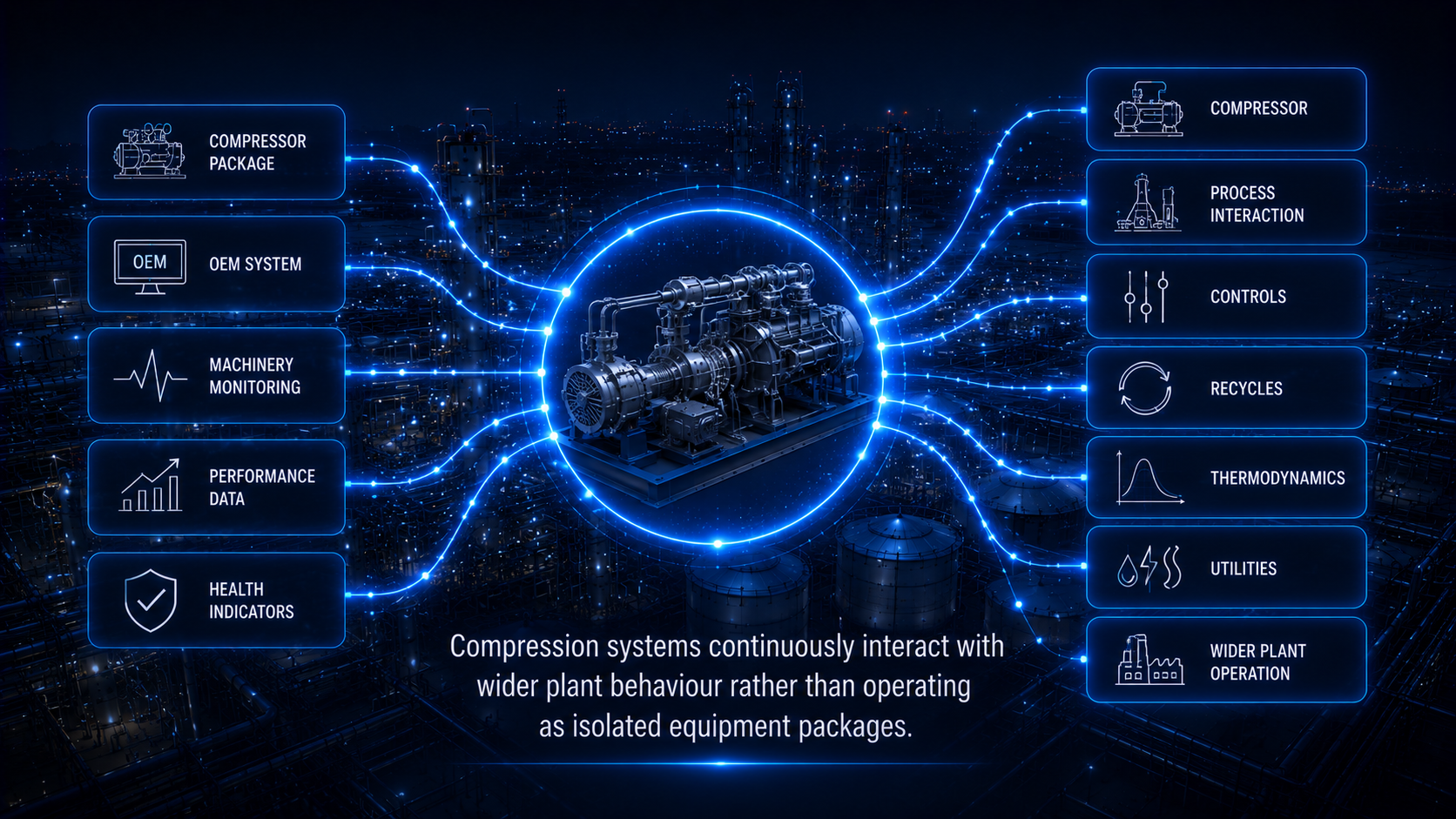
Turbomachinery is often evaluated through performance data, compressor maps, machinery monitoring, vibration analysis, OEM tools, and equipment health systems focused primarily on the machine itself.
These technologies provide important operational information, but machinery behaviour is continuously influenced by changing suction and discharge conditions, thermodynamic state, control actions, recycle behaviour, anti-surge response, process constraints, and wider plant interaction.
A compressor or turbine may be mechanically healthy and still perform differently because the plant environment around it has changed. Likewise, an apparent machinery issue may in fact reflect wider process interaction, recycle response, control behaviour, or changing operational constraints elsewhere in the facility.
Understanding machinery performance therefore requires visibility beyond the equipment boundary.
Machinery behaviour extends beyond isolated equipment performance.
Plant conditions continuously influence machinery behaviour
Oil & gas facilities do not operate at fixed conditions. Process demand changes. Thermodynamic state changes. Controls respond. Recycles open and close. Anti-surge systems intervene. Upstream and downstream constraints shift the operating environment in which the machinery is working.
These changes can directly influence machinery performance, operating limits, efficiency, surge margin, throughput capability, and wider plant response. A change in suction pressure, discharge conditions, recycle flow, or process routing may alter the operating behaviour of a compression system even when the machinery itself has not changed.
Machinery behaviour therefore cannot be fully understood without understanding the changing plant conditions that continuously shape it.
Plant conditions continuously shape machinery performance.
Understanding machinery performance requires understanding the wider plant
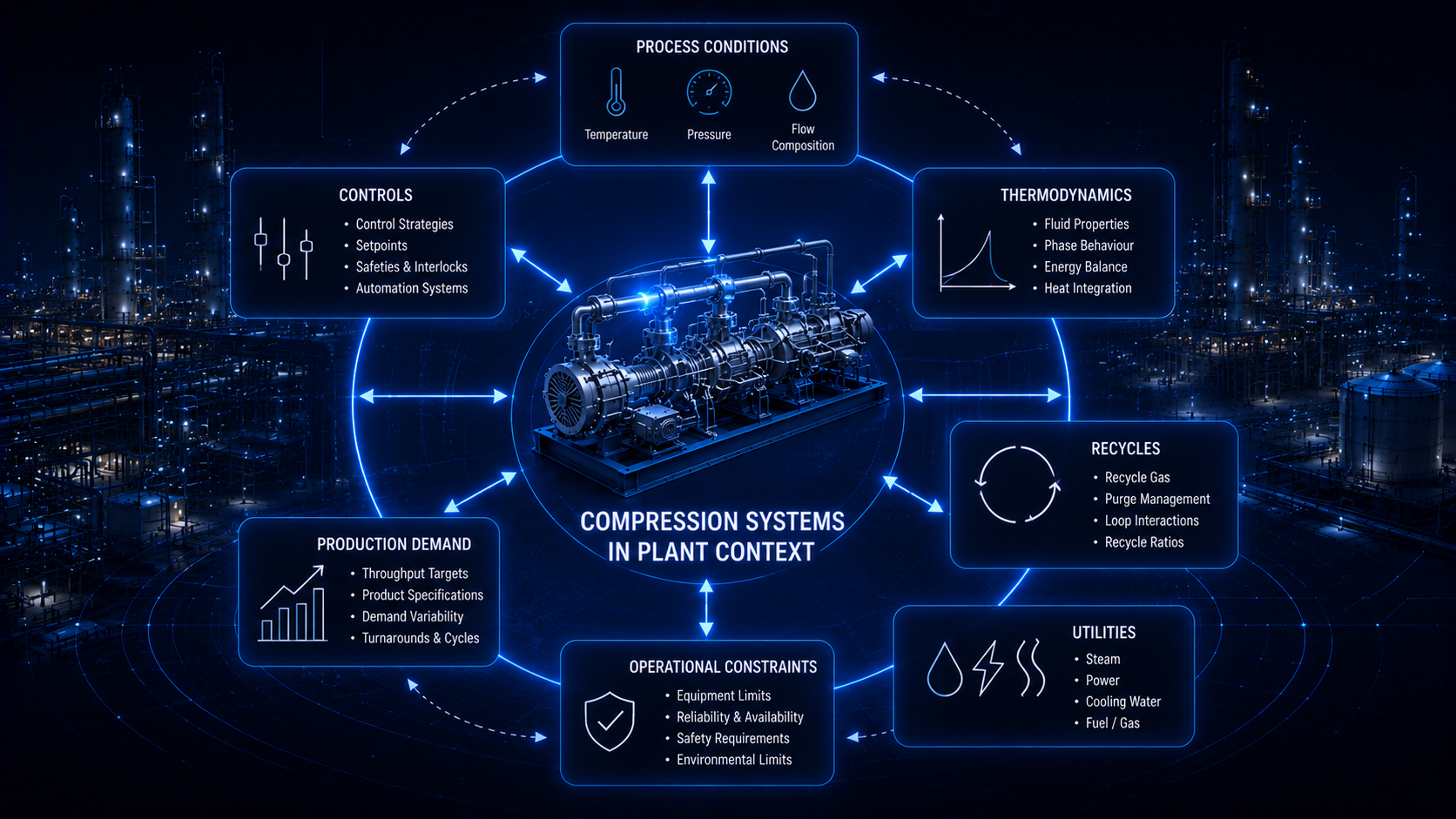
Machinery performance is not defined solely by the machine. It is shaped by the interaction between the machine and the plant in which it operates.
Changes in process conditions, thermodynamic state, control response, recycle behaviour, or operational constraints can influence:
- Compressor efficiency
- Throughput capacity
- Surge margin
- Operating limits
- Energy consumption
- Plant stability
- Production capability
- Wider operational response
If machinery analysis remains isolated from plant context, it can become difficult to determine whether performance changes originate from the machine itself, from wider process behaviour, from control response, or from changing operational conditions elsewhere in the facility.
Understanding machinery behaviour therefore requires a wider operational view of the plant.
Machinery performance must be understood within plant context.
Machinery should be evaluated as part of wider plant behaviour
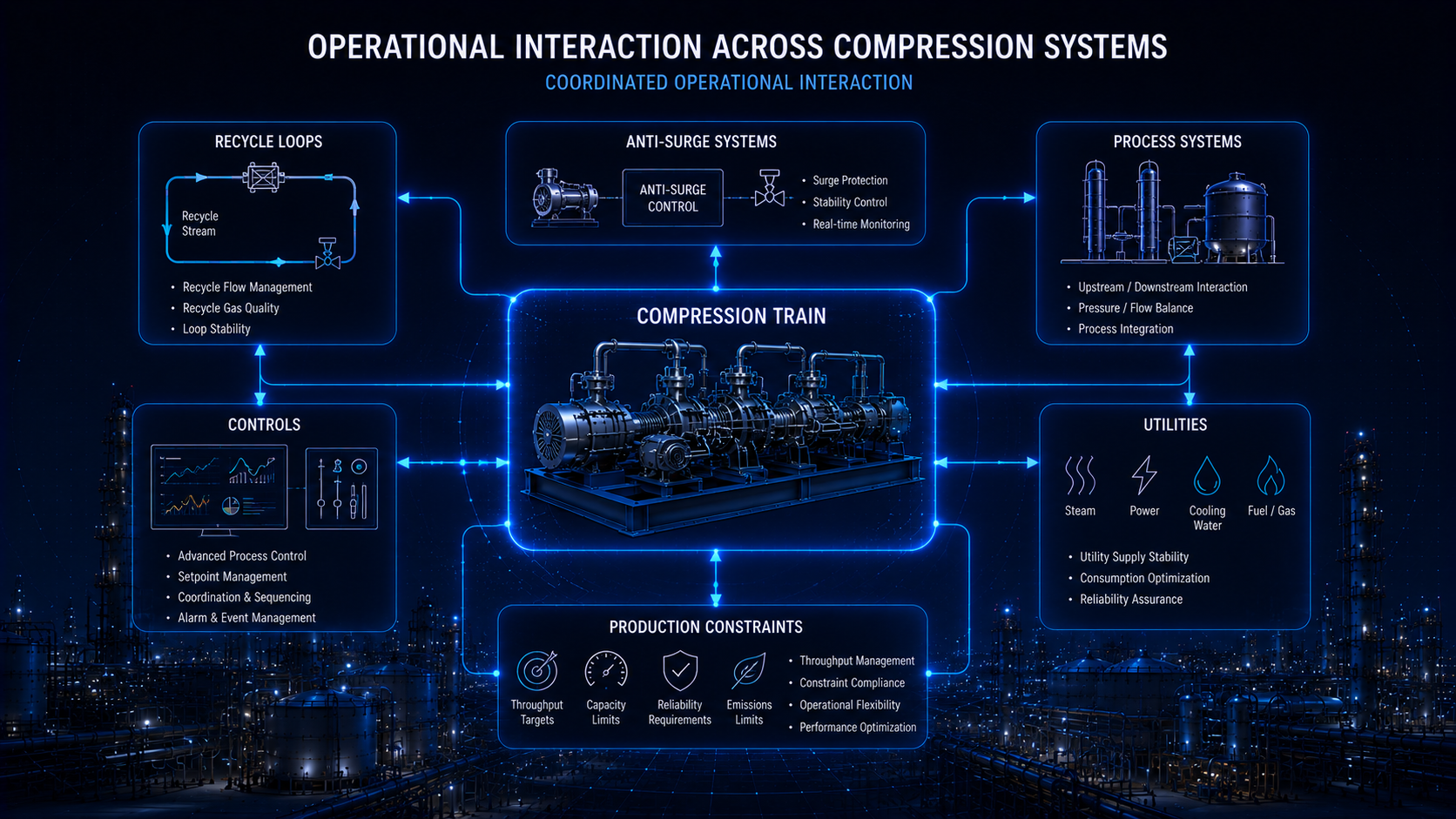
Simulytica was developed to continuously relate machinery behaviour to wider plant operation through coordinated industrial systems combining simulation, monitoring, thermodynamics, process interaction, controls, recycle behaviour, and operational visibility within one plant-aware environment.
Rather than evaluating machinery independently from the operating facility, plant-aware machinery operation continuously relates machinery performance to the wider operational conditions influencing how the equipment behaves.
This allows engineering and operational teams to better evaluate:
- Machinery performance
- Thermodynamic response
- Recycle interaction
- Control interaction
- Anti-surge behaviour
- Operating limits
- Throughput capability
- Wider plant response
Plant-aware machinery operation therefore provides a broader and more realistic view of machinery behaviour across real industrial facilities.
Plant-aware machinery requires plant-aware systems.
Machinery behaviour cannot be fully understood in isolation from the plant
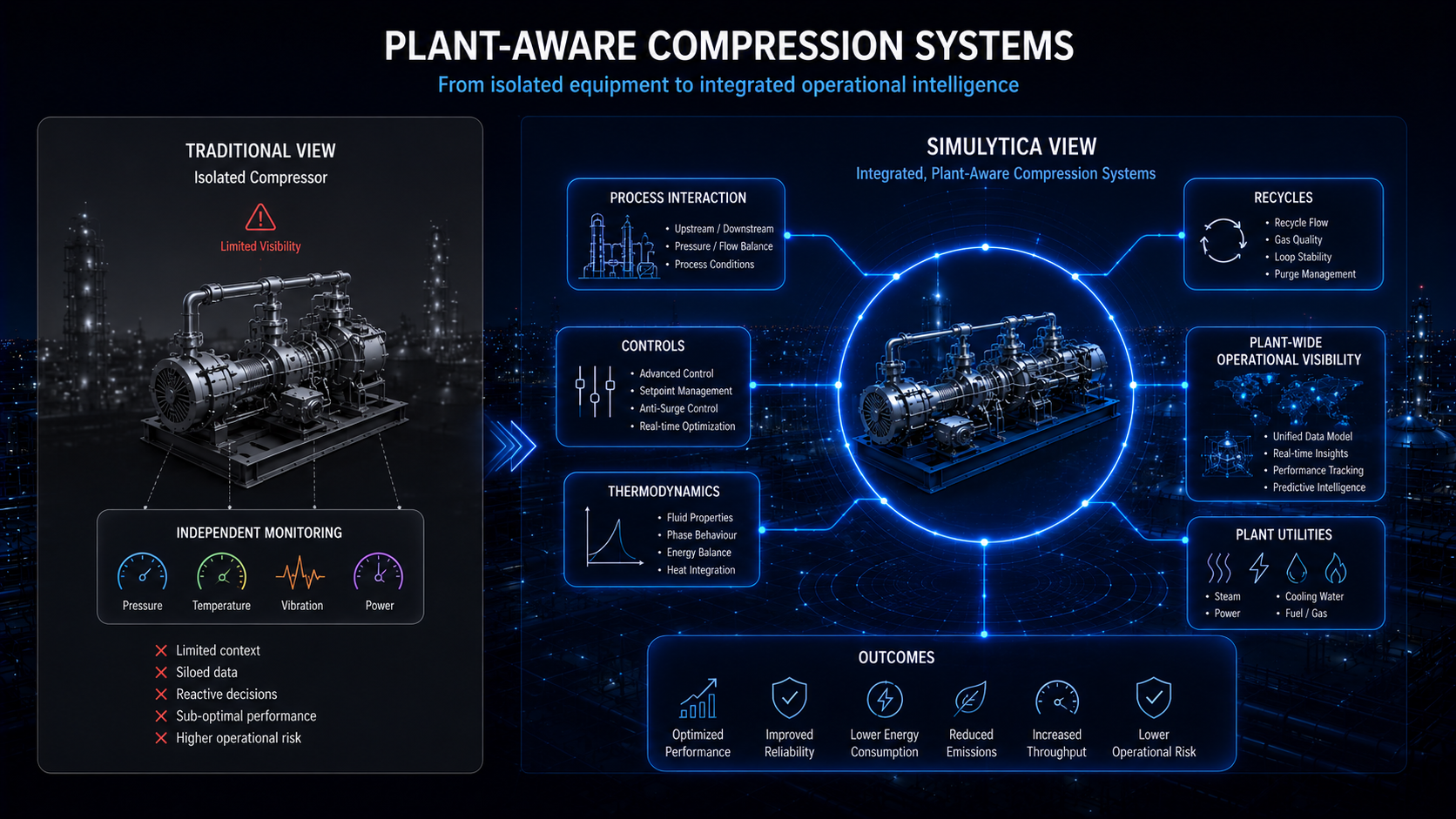
Industrial facilities do not operate through isolated equipment behaviour. Machinery continuously interacts with process conditions, controls, thermodynamics, recycles, anti-surge systems, production constraints, and wider operational response across the plant.
This means machinery performance cannot be fully understood through equipment-centric monitoring alone. A broader operational picture is required, one that continuously relates the machine to the plant conditions shaping how it behaves.
Simulytica approaches this challenge through coordinated industrial systems designed to continuously represent machinery behaviour within wider plant interaction rather than separating equipment performance from the plant environment around it.
Plant-aware machinery therefore provides a stronger foundation for understanding industrial operation, machinery performance, and wider plant behaviour across engineering and plant operation.
Machinery performance requires plant context.