
Monitoring and simulation are often treated as independent disciplines
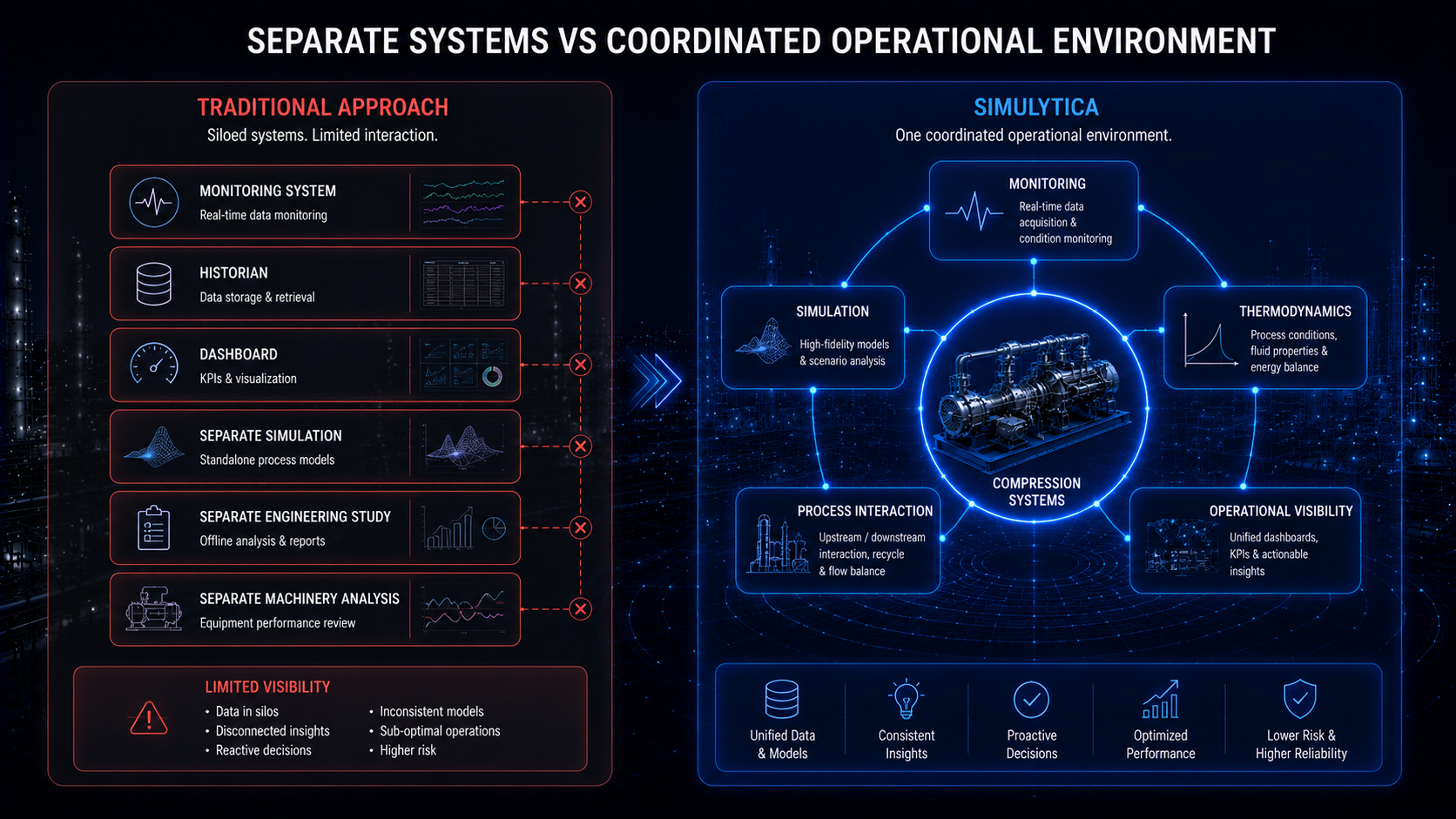
Monitoring systems are typically designed to capture operational data, alarms, performance indicators, and equipment behaviour from live facilities. Simulation systems are often used separately for engineering studies, operational analysis, performance evaluation, design verification, or process modelling.
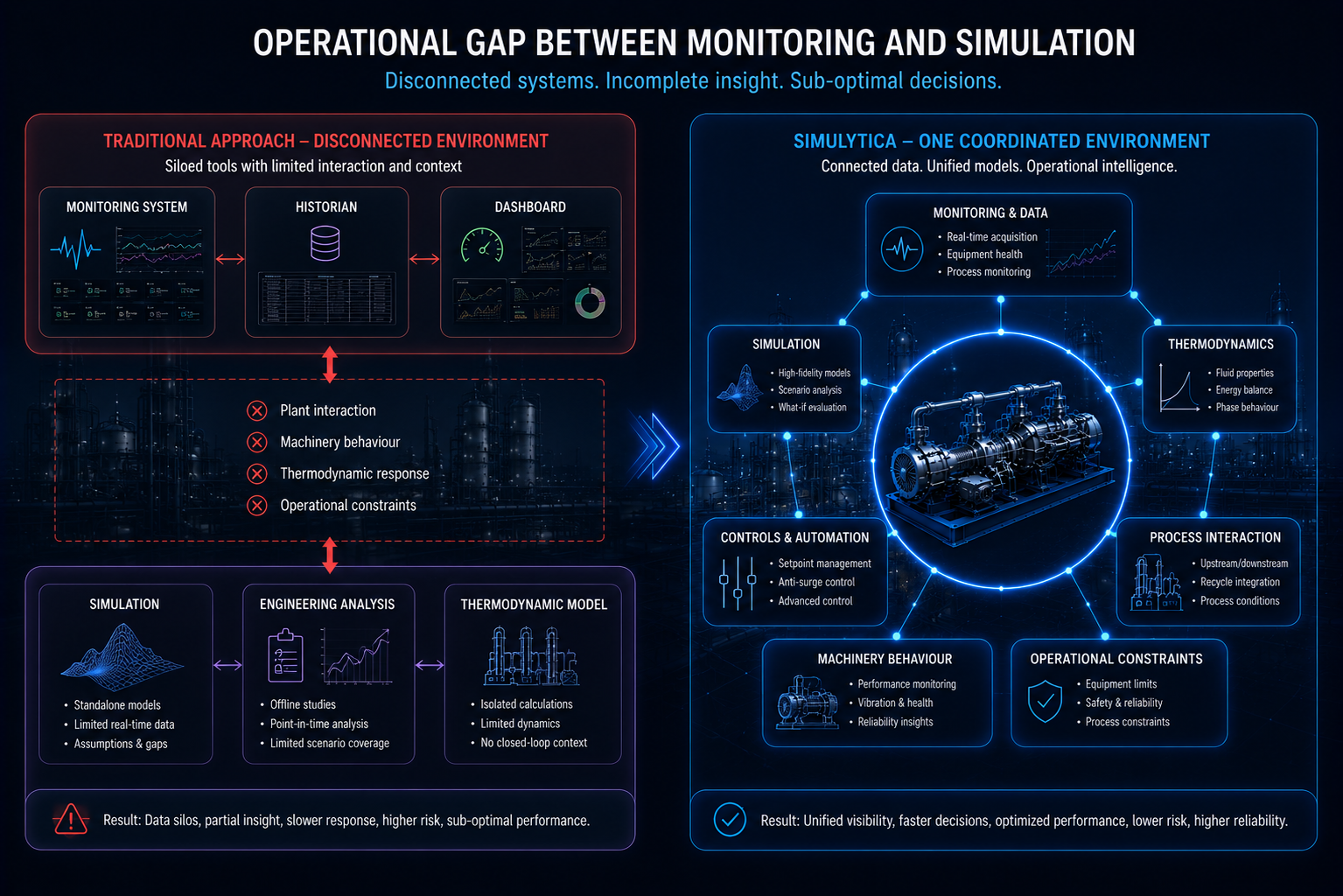
Each discipline provides important value in its own right. However, when simulation and monitoring operate independently, it can become difficult to continuously relate plant behaviour, machinery performance, thermodynamic response, operational constraints, and changing process conditions across one coherent operational environment.
Separate technologies can make it harder to continuously evaluate how the plant is actually behaving.
Plant behaviour extends beyond separate monitoring and simulation environments.
Plant behaviour changes continuously across live operational conditions
Industrial facilities do not pause between monitoring and simulation.
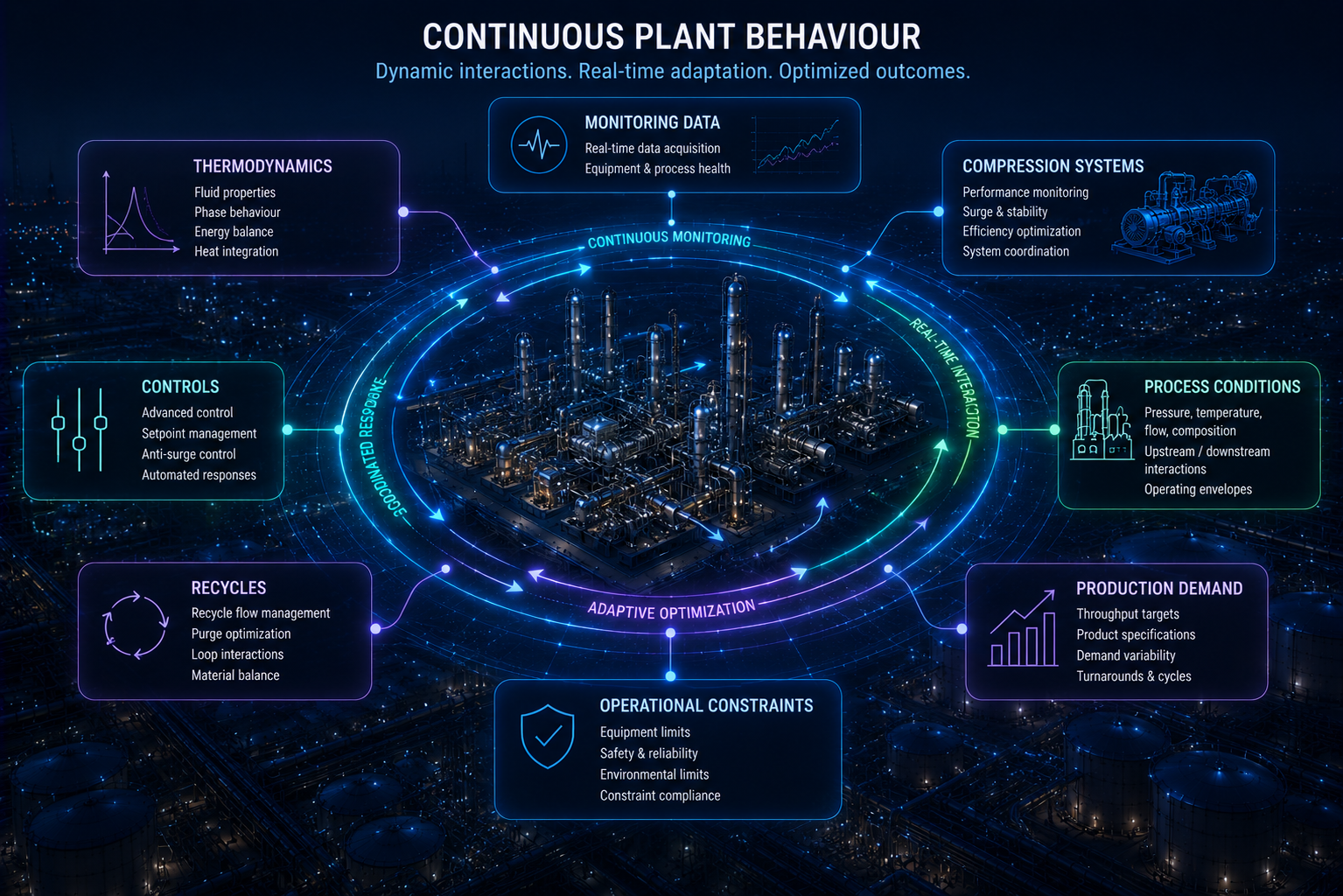
Plant behaviour evolves continuously as thermodynamics, machinery response, controls, recycles, production demand, process interaction, and operational constraints change across the operating environment.
Monitoring captures what is happening in the plant, but understanding why it is happening often requires simulation, thermodynamic interpretation, machinery context, and wider operational understanding.
Similarly, simulation can provide valuable operational insight, but when separated from live operational conditions it may struggle to remain aligned with changing plant behaviour across continuously operating facilities.
Industrial facilities require continuously coordinated operational understanding.
Understanding plant behaviour requires live operational context and plant representation together
When monitoring and simulation are separated, operational teams may have visibility into what the plant is doing without being able to continuously relate that behaviour to thermodynamics, process interaction, machinery constraints, or wider plant response.
Likewise, engineering studies may provide valuable analysis but remain detached from the continuously changing operational conditions that influence machinery behaviour and plant performance in practice.
This gap becomes particularly important across:
- Compressor systems
- Recycle behaviour
- Anti-surge systems
- Thermodynamic interaction
- Process constraints
- Plant performance
- Production capability
- Remote and unmanned facilities
A wider understanding of plant behaviour requires monitoring and simulation to be continuously related rather than isolated from one another.
Separate systems can leave important operational relationships disconnected.
Monitoring and simulation should contribute to one operational representation of the plant
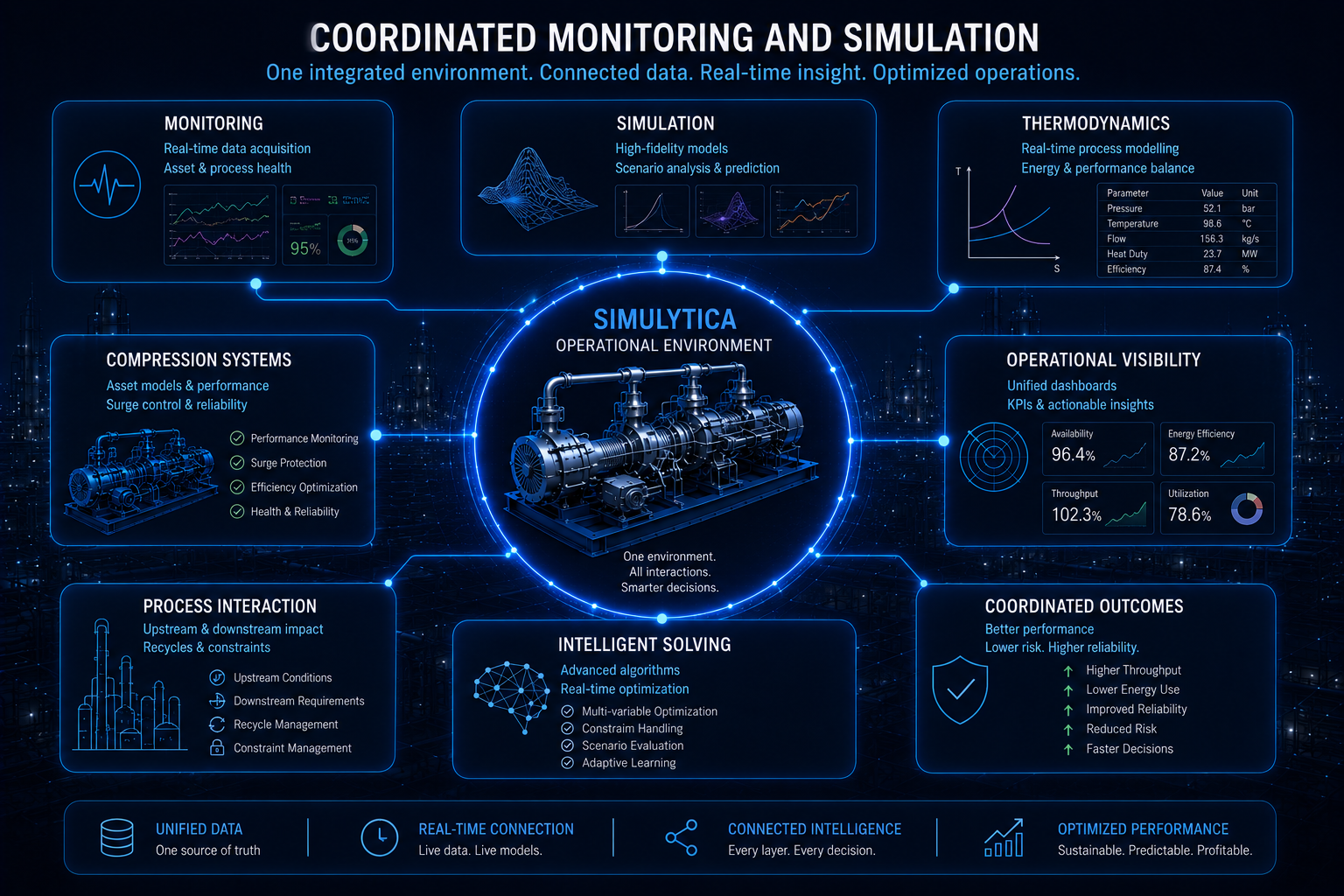
Simulytica was developed to continuously coordinate simulation, monitoring, thermodynamics, machinery behaviour, operational visibility, and wider process interaction within one industrial system.
Rather than treating simulation and monitoring as separate environments, they are continuously related within a coordinated operational context capable of representing how the plant is actually behaving.
This allows engineering and operational teams to better evaluate:
- Plant behaviour
- Machinery response
- Thermodynamic interaction
- Operational efficiency
- Production capability
- Operating limits
- Compression-system performance
- Wider plant interaction
By continuously relating monitoring and simulation in this way, industrial facilities can move beyond fragmented operational technologies toward a more complete representation of plant behaviour.
Plant behaviour requires coordinated monitoring and simulation.
A coordinated plant view requires monitoring and simulation to work together
A plant cannot be fully understood through live data alone, nor through standalone simulation detached from live operational conditions.
Monitoring provides essential operational visibility. Simulation provides essential interpretive and predictive capability. Thermodynamics and machinery analysis provide operational meaning. Process interaction provides context. Plant representation requires all of these disciplines to be continuously related.
Simulytica approaches this challenge through one coordinated industrial system designed to continuously represent plant behaviour across engineering and plant operation rather than separating operational visibility from simulation and analysis.
Monitoring and simulation should not be separate because plant behaviour itself is not separate.
Plant behaviour requires coordinated systems.